

When Are Forex Markets Most Volatile
FX markets are susceptible to a range of factors which affect their volatility, and many traders await to tailor their strategies to capitalize on the most volatile currency pairs.
Currency volatility, often measured by calculating the standard deviation or variance of currency price movements, gives traders an idea of how much a currency might move relative to its average over a given time period. Traders can also estimate volatility past looking at a currency pair's average true range or by looking at range equally percent of spot.
The higher the level of currency volatility, the higher the degree of risk, and vice versa. Volatility and risk are usually used as interchangeable terms.Different currency pairs take dissimilar levels of volatility on average.
Some traders enjoy the higher potential rewards that come with trading volatile currency pairs. Although, this increased potential reward does nowadays a greater risk, so traders should consider reducing their position sizes when trading highly volatile currency pairs.
What are the most volatile currency pairs?
The most volatile major currency pairs are:
- AUD/JPY (Australian Dollar/Japanese Yen)
- NZD/JPY (New Zealand Dollar/Japanese Yen)
- AUD/USD (Australian Dollar/US Dollar)
- CAD/JPY (Canadian Dollar/Japanese Yen)
- AUD/GBP (Australian Dollar/Pound Sterling)
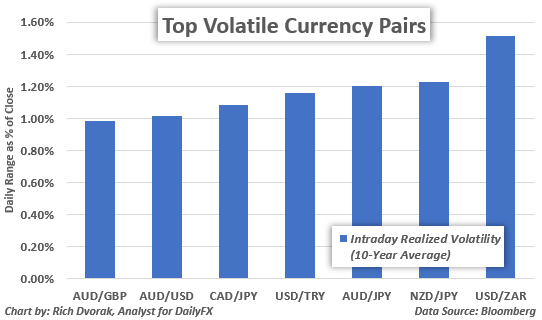
Other major currency pairs, like EUR/USD, USD/JPY, GBP/USD and USD/CHF, are more often than not more liquid and less volatile every bit a result. That said, emerging marketplace currency pairs, such as USD/ZAR, USD/Endeavour and USD/MXN, can clock some of the highest volatility readings.
MOST VOLATILE CURRENCY PAIRS
Majors - AUD/JPY, NZD/JPY, AUD/USD, CAD/JPY, GBP/AUD
Emerging Markets - USD/ZAR, USD/TRY, USD/MXN
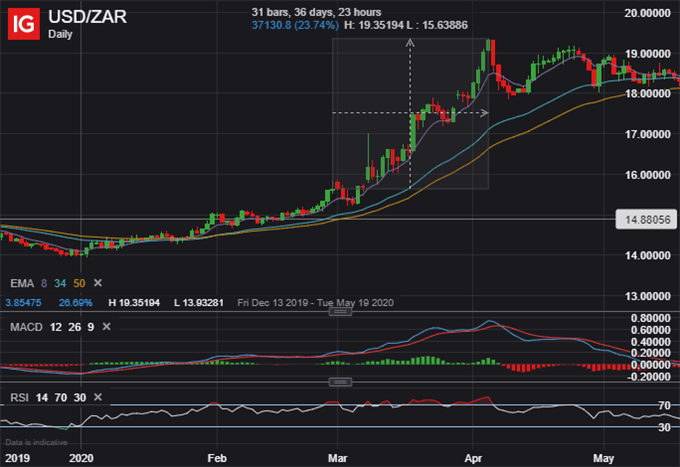
Aside from relatively low liquidity, emerging market currencies tend to be highly volatile in detail due to inherent risk underpinning emerging market economies. The chart below gives an example of how volatile emerging market currencies can be, which shows USD/ZAR (The states Dollar/South Africa Rand) exploding about 25% college in only over a month's fourth dimension. There are several other examples of emerging market place currency pairs swinging drastically like this throughout history.
What about the to the lowest degree volatile currency pairs?
The to the lowest degree volatile currency pairs tend to be the major currency pairs which are also the most liquid. Also, these economies tend to be larger and more developed. This attracts more trading volume and facilitates greater price stability in plow. To that end, considering EUR/USD, USD/CHF and EUR/GBP trade with high volumes of liquidity, it comes as piddling surprise they are amongst the charter volatile currency pairs.
Illustrated below, the average true range (ATR) on USD/CHF ranges between 45-pips and 65-pips, a low average true range compared to other pairs. The average truthful range of a currency is one of the many ways to measure out the volatility of a currency pair. Bollinger Band width is another popular technical indicator used to measure volatility.
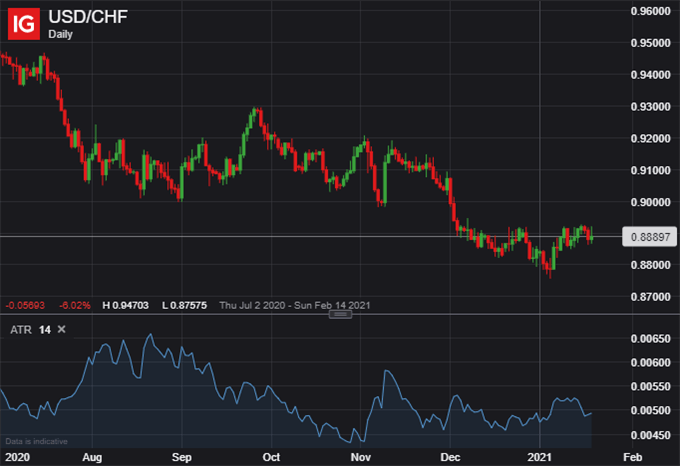
Correlation between two currencies tin also have an touch on on their volatility. The more positively 2 currencies are correlated to 1 another might lead to less volatility. Continuing with our USD/CHF example, we note that the The states Dollar and Swiss Franc are both viewed as safe-haven currencies.
The US Dollar and Swiss Franc tend to strengthen confronting their sentiment-linked peers when the market place experiences episodes of risk disfavor, merely the two currencies may non deviate much from each other. This contributes to relatively low volatility readings for USD/CHF.
How to trade currency pair volatility
Forex traders should take into account current readings of volatility and potential changes in volatility when trading. Market participants should also consider adjusting their position sizes with respect to how volatile a currency pair is. Trading a volatile currency pair might warrant a reduced position size.
Awareness of volatility tin too aid traders determine advisable levels for end loss and take profit limit orders. Furthermore, it is important to empathize the key characteristics separating themost volatile currencies from currencies with low volatility readings. Traders should as well know how to mensurate volatility and have an awareness of events that might create large changes in volatility.
The difference between trading currency pairs with high volatility versus low volatility
- Currencies with high volatility will usually movement more than pips over a certain period than currencies with low volatility. This leads to increased risk when trading currency pairs with high volatility.
- Currencies with high volatility are more prone to slippage than currency pairs with low volatility.
- Due to high-volatility currency pairs making bigger moves, you should determine the correct position size to have when trading them.
There are several ways to measure volatility
To determine the right position size, traders need to accept an expectation of how volatile a currency can exist. A variety of indicators can be used to measure volatility like:
- Average true range (ATR).
- Donchian channels.
- Moving averages (by comparing the moving average to the current toll).
Traders can also look at implied volatility readings, which reflect the level of expected volatility derived from options.
Key things traders should know about volatility:
- Big news events like Brexit or trade wars can take a major impact on a currency's volatility. Data releases can also influence volatility. Traders can stay alee of data releases past using an economic calendar.
- Volatile currency pairs however obey many technical aspects of trading, like support and resistance levels, trendlines and price patterns. Traders can take advantage of the volatility using technical analysis in combination with strict risk direction principles.
- Staying up to date with the latest forex pair news, analysis and rates can aid y'all predict possible changes in volatility. We provide comprehensive trading forecasts to help yous navigate the market place.
- DailyFX hosts daily webinars to answer questions and assist traders prepare for volatile market conditions.
- Supplement your forex learning and strategy development with the DailyFX Education Center.
If you'd like to follow prices in the pairs listed to a higher place, the demo account can allow access to a alive price feed along with a full suite of tools, charts and indicators. Click here to request a complimentary demo with IG grouping
DailyFX provides forex news and technical assay on the trends that influence the global currency markets.

Source: https://www.dailyfx.com/education/volatility/most-volatile-currency-pairs.html
Posted by: olsonwhousethal.blogspot.com
0 Response to "When Are Forex Markets Most Volatile"
Post a Comment